
Public Perception and Behavior Patterns of Kurdistan Parliament Members

The public's perception of Members of Parliament is largely shaped by their financial status and earnings. As the Kurdistan Parliament's influence and prestige have declined, the position has increasingly attracted individuals primarily interested in its financial advantages - notably the substantial salary and guaranteed retirement benefits, along with potential unofficial income through various arrangements.
This focus on financial gain has damaged the parliament's reputation so severely that competent individuals often avoid joining to protect their own standing, not wanting to be associated with an institution that has become a source of public mockery. This decline can be partially attributed to the approach of opposition groups like the Gorran movement, which discouraged experienced politicians and decision-makers (such as members of KDP and PUK politburos) from participating in parliament. Instead, they often nominated less qualified candidates, ultimately leading even their more capable MPs to resign.
The sudden wealth that comes with being an MP, combined with minimal workload and weak oversight, has led to problematic behavior patterns. For example, in the previous parliament, around a dozen MPs took second wives, directly violating the Kurdistan Region's own laws against polygamy - laws that were ironically passed by the same parliament. Many MPs, unused to such wealth and lacking strong moral or institutional constraints, have engaged in inappropriate relationships and misconduct, highlighting the absence of strong cultural and institutional safeguards against such behavior.
A significant social dimension of becoming an MP involves managing expectations from both impoverished relatives and party supporters who anticipate financial assistance. Many MPs report experiencing considerable stress not from their parliamentary duties, but from these social obligations and expectations within their extended family networks.
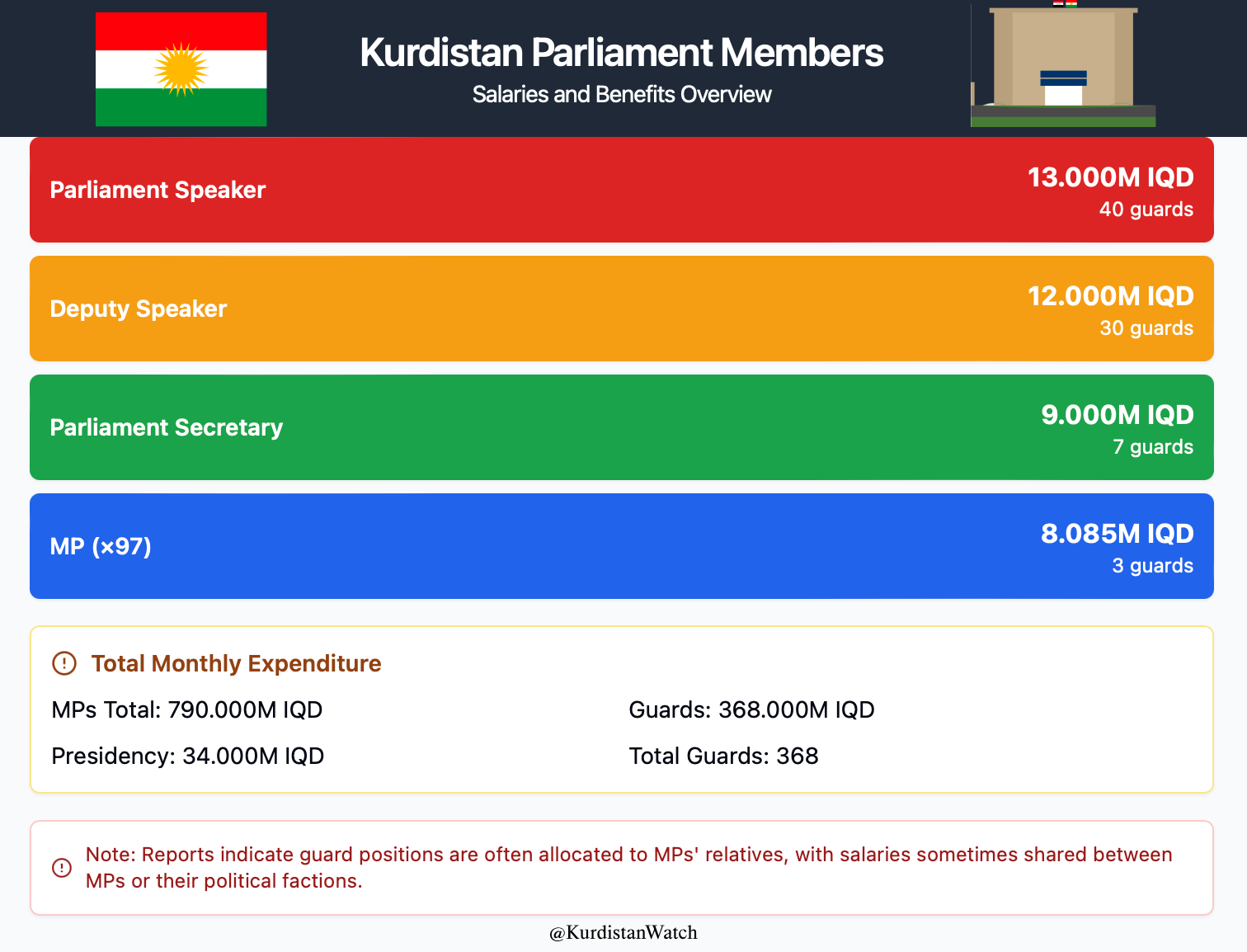
Current Compensation Structure:
Parliament Presidency Board Monthly Salaries:
Parliament Speaker: 13 million dinars
Deputy Speaker: 12 million dinars
Parliament Secretary: 9 million dinars
Regular MP: 8.085 million dinars
Security Detail Allocation:
Parliament Speaker: 40 security personnel
Deputy Speaker: 30 security personnel
Parliament Secretary: 7 security personnel
Regular MP: 3 security personnel
Additional benefits include housing provision and retirement packages.
The total monthly salary expenditure amounts to 790 million dinars for all 97 MPs, plus 34 million dinars for the presidency board.
The combined security detail of 368 personnel, officially employed through the Ministry of Interior, represents another significant expense. With base salaries starting at 900,000 dinars and averaging approximately one million dinars, the monthly security payroll reaches 368 million dinars. It's worth noting that these security positions are often nominal, with positions frequently allocated to MPs' relatives who may share their salaries with either the MPs themselves or their political factions.